
President Museveni & Obasanjo meet to advance dairy export strategy
Central to their talks was the expansion of Uganda’s dairy exports, with a focus on promoting finished dairy products rather than raw milk.
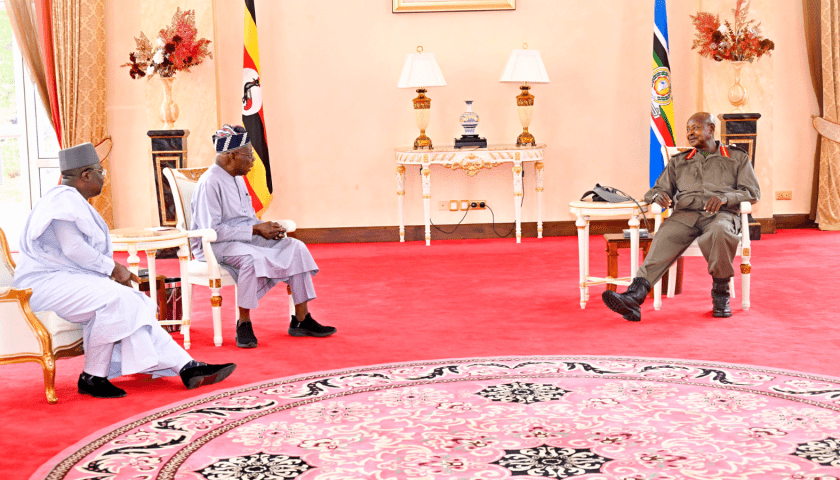
UGANDA – President Yoweri Kaguta Museveni of Uganda welcomed former Nigerian President Olusegun Obasanjo for high-level discussions focused on strengthening economic cooperation between Uganda and Nigeria.
President Museveni emphasized Uganda’s strategic shift from exporting raw milk to prioritizing value-added dairy products.
Uganda’s dairy sector has become one of the country’s leading agro-industrial success stories, with processed milk and related products increasingly finding markets beyond East Africa.
Obasanjo praised Uganda’s agricultural progress and expressed strong interest in facilitating business links between Ugandan dairy producers and Nigerian markets.
He also highlighted broader opportunities for trade and investment between the two nations, aligning with the goals of the African Continental Free Trade Area (AfCFTA), which seeks to reduce trade barriers and promote intra-African commerce.
The meeting builds on previous engagements, including Obasanjo’s visit to Pearl Dairy Farms in Mbarara City, where he witnessed firsthand Uganda’s growing dairy capabilities.
During the visit, the president toured Pearl Dairy Farms in Mbarara and expressed Nigeria’s willingness to buy processed Ugandan milk.
Obasanjo noted that Nigeria has long imported dairy from Europe, but with Uganda producing 5.7 billion liters of milk annually, sourcing milk from Africa presents a more strategic option.
The partnership comes as Nigeria grapples with a significant dairy production shortfall.
According to Sabi Abdullahi, Nigeria’s Minister of State for Agriculture and Food Security, the country consumes 1.6 billion liters of milk annually but fails to meet 60% of this demand, leading to $1.5 billion in yearly dairy imports.
This shortfall has also contributed to widespread nutritional deficiencies, with two million Nigerian children suffering from severe acute malnutrition (SAM), a condition worsened by inadequate access to animal-source foods like milk.
Uganda, Africa’s leading milk exporter, stands to benefit greatly from this arrangement. Despite recent challenges, including Kenya’s ban on Ugandan powdered milk to protect its local producers, Uganda’s dairy industry continues to expand.
In 2023, Uganda’s dairy export value reached $264.5 million, with milk exports remaining a critical part of East African trade.
President Museveni expressed confidence in Uganda’s ability to meet both local and international demand. He emphasized the need for farmers to adopt more efficient practices, such as zero-grazing and silage use, to boost production further.
Subscribe to receive our email newsletters with the latest news and insights from Africa, the Middle East and around the world. SUBSCRIBE HERE

Be the first to leave a comment