
President Museveni backs Egyptian investment in Ngoma dairy project
According to Museveni, the project will strengthen Uganda’s dairy sector, promote value addition and create opportunities for farmers.
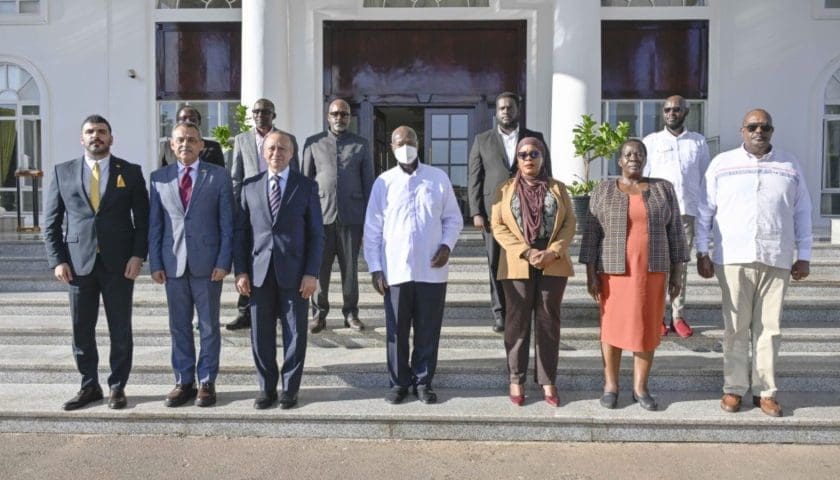
UGANDA – President Yoweri Kaguta Museveni has welcomed plans by Egyptian investors to establish a modern dairy processing facility in Ngoma, Nakaseke District.
The proposed facility will have the capacity to process up to one million litres of milk per day, with modern infrastructure, mechanised equipment and improved milk handling systems.
There will be modern milk collection methods, including milking equipment and transport systems, to ensure quality from the farm to the factory.
President Museveni noted that the project will strengthen Uganda’s dairy sector, promote value addition and create opportunities for farmers.
He noted that Uganda’s transition from traditional dairy production methods to mechanised systems is achievable, as the country has already developed a strong foundation in milk production.
Additionally, he noted that Uganda’s dairy industry has grown significantly, and the country now produces about 5.4 billion litres of milk annually.
The Egyptian delegation said it was committed to strengthening cooperation with Uganda for mutual benefit.
Maj. Gen. Khalid Abdul Nasser explained that the Arab Organization for Industrialization was established in 1975 and has developed expertise in several sectors, including manufacturing, railway systems, renewable energy and electronics.
He said the decision to explore investment opportunities in Uganda followed engagements with Ugandan officials and assessment of the dairy sector.
Uganda unveils Green Dairy Investments Project to boost dairy industry
Recently, the Ministry of Agriculture, Animal Industry and Fisheries launched the Green Dairy Investments Project (GDIP), a major initiative aimed at increasing milk production, raising farmer incomes, and promoting environmentally sustainable dairy farming practices.
In partnership with Heifer International and aBi Development, the initiative aligns with Uganda’s broader development frameworks, including the National Development Plan and the Parish Development Model.
Both aim to transition households from subsistence to market-oriented production while strengthening climate resilience and economic competitiveness.
The GDIP seeks to address these bottlenecks by promoting climate-smart technologies, establishing structured dairy hubs, and strengthening private sector participation along the dairy value chain.
To receive our email newsletters with the latest news and insights from Africa, the Middle East and around the world, SUBSCRIBE HERE
Be the first to leave a comment